
Disclaimer
The information provided in this article, "Understanding and Treating Gum Disease: A Complete Guide to Periodontal Health," is for informational purposes only and is not intended to be a substitute for professional medical advice, diagnosis, or treatment. Always seek the advice of your dentist, physician, or other qualified healthcare provider with any questions you may have regarding a medical condition or treatment.
Never disregard professional medical advice or delay seeking treatment because of information you have read in this guide. If you suspect you have gum disease or any other health condition, consult a licensed healthcare professional promptly.
Losing a tooth can impact more than just your smile. It can change the way you eat, speak, and feel about yourself every day. Many people try to hide the gap by avoiding certain foods, covering their mouth when laughing, or feeling nervous in social situations. If this sounds familiar, you’re not alone — and you don’t have to live that way forever. Dental implants offer a long-lasting and natural-looking solution that can help you feel confident again.
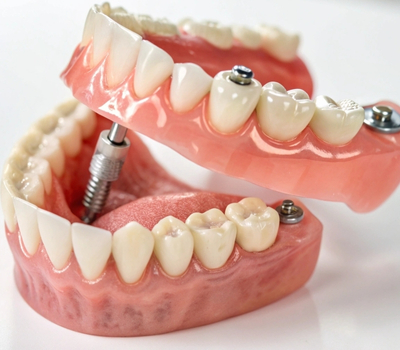
A dental implant is a strong, artificial tooth root that is placed in the jawbone. Once healed, it supports a custom-made crown that looks and functions just like a real tooth. Unlike dentures, implants don’t slip or move when you talk or eat. They become part of your smile, allowing you to enjoy your favorite foods and speak with confidence.
Millions of patients choose dental implants because they restore not only their appearance, but also their comfort, health, and self-esteem. Whether you’re missing one tooth or several, implants may be the solution you’ve been searching for. If you are ready to reclaim your smile with something that feels natural and secure, dental implants could be the perfect fit for you.
Types of dental implants
When it comes to restoring missing teeth, there isn’t just one “one-size-fits-all” implant—there are several tailored options depending on how many teeth are missing and what your jaw supports.
Single-tooth implants
Ideal when you’re missing just one tooth. A single titanium post goes into the jaw and is capped with a crown that blends seamlessly with your other teeth.
Multiple teeth / implant-supported bridges
Used when you’re missing several adjacent teeth. Instead of placing a post for each tooth, a few implants support a bridge of crowns, helping you restore a segment of your smile efficiently.
Full-arch solutions (such as “All-on-4” style)
For those missing most or all teeth in one jaw, a full set of prosthetic teeth is anchored on four (or more) implants. This provides a fixed, stable restoration that functions like natural teeth.
Mini implants (or narrow-diameter implants) for special cases
These are smaller-sized implants used when space is tight, bone volume is limited, or a less invasive option is preferred. Great for specific conditions where traditional implants may not be ideal.
Why would I need a dental implant?
When one or more teeth go missing, it’s not just about how your smile looks — there are important reasons to consider a dental implant. A dental implant is essentially a small post placed into your jawbone that replaces the missing tooth root and supports a natural-looking restoration. By restoring what’s underneath the surface, an implant helps you:
- Chew more effectively and comfortably
- Speak clearly without gaps or worry
- Preserve the underlying jawbone so it doesn’t shrink away
- Avoid altering your neighboring healthy teeth (as with some bridges)
- Smile and laugh with confidence again
Tooth loss often happens because of things like cavities, a cracked or broken tooth, gum disease, or even teeth that never developed. Over time, missing teeth can affect not only your ability to eat your favorite foods but also how you feel about your mouth and yourself. With a dental implant, you’re choosing a solution that mimics a natural tooth in both look and function — and because it anchors directly in your bone, it stays stable instead of shifting like removable options. If you’ve lost one or several teeth and you want to regain full comfort, appearance, and jaw strength, an implant might be the ideal choice.
How do dental implants work?
When you choose a dental implant, you’re selecting a solution that closely mimics the structure and strength of a natural tooth. Here’s what happens:
- A small titanium post is placed into your jawbone to act like a tooth root. Because it’s made of titanium, it integrates with your bone so strongly it becomes a stable foundation rather than a loose fixture.
- After placement, there’s a healing period during which your jawbone gradually bonds with the implant. This bone-to-implant connection is what gives the final restoration solidity and durability.
- Once the implant is firmly integrated and your gums have healed, a custom-made crown (designed to match your other teeth in shape and color) is attached. This final piece completes the look and function of a natural tooth.
Because of this root-like system plus strong bone attachment, dental implants offer excellent stability. They won’t shift, slip, or put extra stress on adjacent teeth. Instead, you get a long-term, solid solution that behaves much like a natural tooth in both appearance and performance.

Do dental implants hurt?
Many people worry about pain when they think about getting a dental implant, but the truth is that the procedure is designed to be as comfortable as possible. Most patients say the experience is no worse than a routine tooth extraction — and in many cases, even easier than they expected.
Here’s what you can expect:
- During the procedure
- A local anesthetic numbs the area completely
- Sedation can be offered if you feel nervous
- You may feel some pressure, but not sharp pain
- Many patients compare it to a simple filling appointment
- After the procedure
- Mild soreness, swelling, or a little bruising is normal
- Any discomfort usually peaks within the first day or two
- Over-the-counter pain relievers are often all that’s needed
- Ice packs, soft foods, and resting help the healing process
- What affects comfort?
- The number of implants placed
- Whether bone grafting was needed
- Everyone’s pain tolerance is different — and that’s okay
Once the area is healed, your implant should feel completely natural — no ongoing pain or irritation. With modern techniques and gentle care, the short-term discomfort is minimal compared to the long-term benefits: a stronger bite, better oral health, and a smile you can feel proud of.
Caring for dental implants
Once your dental implant is in place and fully healed, it behaves like a natural tooth — but its long-term success depends on good daily care and regular professional check-ups. With the right routine, your implant can last for many years.
- Brush and floss like your natural teeth — Clean around the implant crown and gum line twice a day. Use a soft-bristle brush and floss or interdental cleaner to remove plaque just as you would with your regular teeth.
- Visit your dentist for professional cleanings — Just like natural teeth, implants benefit from periodic examinations and cleanings by a dental hygienist and your implant dentist. These visits help spot any early issues before they become bigger problems.
- Keep it simple — the reward is a long-lasting implant — If you maintain regular hygiene and visits, the implant-supported tooth can remain strong and stable for decades. Many patients enjoy full function and confidence just like they do with their other teeth.
How long will it last?
With proper care and maintenance, a dental implant—meaning the post placed in your jaw—can last a lifetime.
- The implant itself fuses with the jawbone and becomes a stable foundation for your replacement tooth.
- While the implant post is built for lifelong durability, the visible part (such as the crown or bridge it supports) may need upkeep or replacement after a number of years.
- Compared to other tooth-replacement options like traditional dentures or bridges—which may require regular adjustments or replacements—an implant offers significantly better long-term value.