If you’ve been thinking about improving your smile, you’ve probably come across two popular options: dental bonding and porcelain veneers. Both can address similar concerns — chipped teeth, discoloration, gaps, or uneven shapes — but they work quite differently, and the right choice depends on your goals, your budget, and the current condition of your teeth.
At Eastside Family Dentistry, Dr. Armine Janjughazova (known to many of her patients as Dr. Jan) helps patients in East York and Scarborough explore their cosmetic options so they can make a confident, informed decision. Here’s a straightforward breakdown of both treatments to help you understand what each one involves.
What Is Dental Bonding?

Dental bonding is one of the most accessible cosmetic dental procedures available. During the treatment, your dentist applies a tooth-colored composite resin directly onto the surface of the tooth, shapes it, and then hardens it with a special curing light. The result looks and feels like a natural part of your tooth.
Bonding is a great fit for patients who want to:
- Repair a chipped or cracked tooth
- Close small gaps between teeth
- Improve the shape or length of a tooth
- Cover minor staining or discoloration that whitening hasn’t been able to fix
One of the biggest advantages of bonding is how simple and quick it is. In most cases, the whole procedure takes 30 to 60 minutes per tooth and requires very little preparation. There’s usually no need to remove enamel, which means the treatment is reversible if you ever decide to go a different route later. For many patients, it’s a comfortable, low-commitment way to make a noticeable improvement.
Bonding typically lasts between 3 and 10 years, depending on where the tooth is located and how well you care for it. It can chip over time, especially on teeth that take a lot of biting pressure, but it can also be touched up or repaired easily.
Benefits of Dental Bonding
- Fast results — most treatments are completed in a single visit, with no waiting for a dental lab
- Minimal prep work — little to no enamel removal means the natural tooth structure stays intact
- Reversible — because the tooth isn’t permanently altered, you can change course down the road
- Affordable — bonding is one of the most cost-effective cosmetic options available
- Natural appearance — the resin is matched to your tooth color so the result blends in seamlessly
- Easy repairs — if it chips or wears down, it can typically be touched up in a single appointment
What Are Dental Veneers?
Porcelain veneers are ultra-thin shells — about the thickness of a contact lens — that are custom-made and bonded to the front surface of your teeth. They’re designed to look like natural tooth enamel, and because they’re made from porcelain, they reflect light in a way that’s very close to how real teeth look.
Veneers are typically recommended for patients who want:
- A more dramatic or uniform transformation across multiple teeth
- Long-lasting results with minimal maintenance
- A solution for deeper staining that can’t be corrected with whitening or bonding
- A complete smile makeover
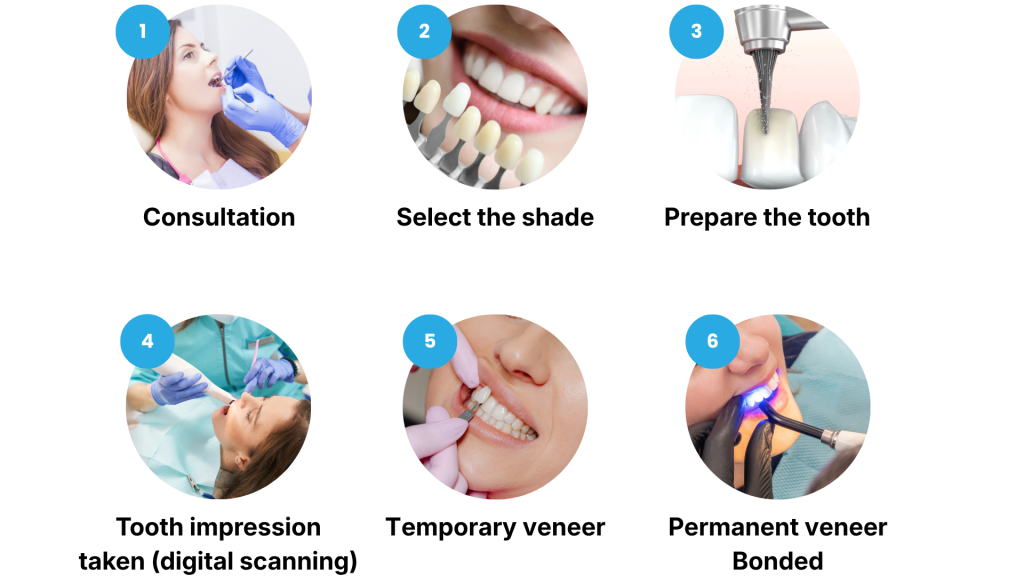
The veneer process usually takes two appointments. At the first visit, your dentist removes a thin layer of enamel from the tooth surface to make room for the veneer — this step is important to ensure the final result sits flush and looks natural. Temporary veneers are placed while your custom ones are being made in a dental lab. At the second appointment, the permanent veneers are bonded in place.
Because enamel is removed, veneers are considered an irreversible treatment. That said, for patients who are committed to the outcome, veneers offer results that are truly transformative and long-lasting. With proper care, they can last 10 to 20 years.
Benefits of Dental Veneers
- Long-lasting results — with proper care, porcelain veneers can last 10 to 20 years
- Stain resistant — porcelain doesn’t absorb coffee, wine, or other pigments the way natural enamel or composite resin can
- Natural-looking finish — the way porcelain reflects light closely mimics the appearance of real tooth enamel
- Covers a wide range of concerns — veneers can address discoloration, chips, gaps, slight misalignment, and uneven sizing all at once
- Consistent smile transformation — because each veneer is custom-made, multiple teeth can be matched and shaped uniformly
- Low maintenance — no special products required; regular brushing, flossing, and checkups are all it takes
Bonding vs. Veneers: A Side-by-Side Look
Here’s a quick comparison to help you see the key differences at a glance:
| Dental Bonding | Porcelain Veneers | |
| Material | Composite resin | Porcelain |
| Procedure time | 1 visit (30–60 min/tooth) | 2 visits |
| Enamel removal | Minimal to none | Yes (thin layer) |
| Reversibility | Yes | No |
| Durability | 3–10 years | 10–20 years |
| Best for | Minor corrections | Comprehensive smile changes |
| Cost | More affordable | Higher investment |
| Stain resistance | Moderate | High (porcelain resists staining) |
So, Which One Should You Choose?
There’s no single answer that works for everyone. Here’s a practical way to think about it:
Choose bonding if: You have a minor cosmetic concern — a small chip, a gap, or slight discoloration — and you want a fast, affordable fix that doesn’t require major dental work. It’s also a great starting point if you’re not ready to commit to something permanent.
Choose veneers if: You want a significant, lasting change to the appearance of your smile. If you have multiple teeth you’d like to improve, or if your concerns go beyond what bonding can realistically address, veneers tend to produce more dramatic and more durable results.
It’s also worth noting that the two treatments aren’t mutually exclusive. In some cases, a combination approach makes the most sense — for example, using veneers on the most visible front teeth and bonding to address a minor issue elsewhere.
The most important step is having a conversation with your dentist. A proper exam allows Dr. Jan to look at the health and structure of your teeth, understand what outcome you’re hoping for, and give you a realistic picture of what each option would involve for your specific situation.
Ready to Explore Your Options?
Whether you’re curious about a small touch-up or thinking about a complete smile refresh, the team at Eastside Family Dentistry is here to help you figure out the right path forward — without any pressure.
Dr. Jan and her team proudly serve patients across East York, Scarborough, and the surrounding east Toronto neighborhoods. Book a consultation at our O’Connor Drive location and find out which cosmetic treatment is the best fit for your smile.Call us at (416) 755-4336 or visiteastsidefd.cato schedule your appointment today.If you’ve been thinking about improving your smile, you’ve probably come across two popular options: dental bonding and porcelain veneers. Both can address similar concerns — chipped teeth, discoloration, gaps, or uneven shapes — but they work quite differently, and the right choice depends on your goals, your budget, and the current condition of your teeth.
At Eastside Family Dentistry, Dr. Armine Janjughazova (known to many of her patients as Dr. Jan) helps patients in East York and Scarborough explore their cosmetic options so they can make a confident, informed decision. Here’s a straightforward breakdown of both treatments to help you understand what each one involves.
What Is Dental Bonding?
Dental bonding is one of the most accessible cosmetic dental procedures available. During the treatment, your dentist applies a tooth-colored composite resin directly onto the surface of the tooth, shapes it, and then hardens it with a special curing light. The result looks and feels like a natural part of your tooth.
Bonding is a great fit for patients who want to:
- Repair a chipped or cracked tooth
- Close small gaps between teeth
- Improve the shape or length of a tooth
- Cover minor staining or discoloration that whitening hasn’t been able to fix
One of the biggest advantages of bonding is how simple and quick it is. In most cases, the whole procedure takes 30 to 60 minutes per tooth and requires very little preparation. There’s usually no need to remove enamel, which means the treatment is reversible if you ever decide to go a different route later. For many patients, it’s a comfortable, low-commitment way to make a noticeable improvement.
Bonding typically lasts between 3 and 10 years, depending on where the tooth is located and how well you care for it. It can chip over time, especially on teeth that take a lot of biting pressure, but it can also be touched up or repaired easily.
Benefits of Dental Bonding
- Fast results — most treatments are completed in a single visit, with no waiting for a dental lab
- Minimal prep work — little to no enamel removal means the natural tooth structure stays intact
- Reversible — because the tooth isn’t permanently altered, you can change course down the road
- Affordable — bonding is one of the most cost-effective cosmetic options available
- Natural appearance — the resin is matched to your tooth color so the result blends in seamlessly
- Easy repairs — if it chips or wears down, it can typically be touched up in a single appointment
What Are Dental Veneers?
Porcelain veneers are ultra-thin shells — about the thickness of a contact lens — that are custom-made and bonded to the front surface of your teeth. They’re designed to look like natural tooth enamel, and because they’re made from porcelain, they reflect light in a way that’s very close to how real teeth look.
Veneers are typically recommended for patients who want:
- A more dramatic or uniform transformation across multiple teeth
- Long-lasting results with minimal maintenance
- A solution for deeper staining that can’t be corrected with whitening or bonding
- A complete smile makeover
The veneer process usually takes two appointments. At the first visit, your dentist removes a thin layer of enamel from the tooth surface to make room for the veneer — this step is important to ensure the final result sits flush and looks natural. Temporary veneers are placed while your custom ones are being made in a dental lab. At the second appointment, the permanent veneers are bonded in place.
Because enamel is removed, veneers are considered an irreversible treatment. That said, for patients who are committed to the outcome, veneers offer results that are truly transformative and long-lasting. With proper care, they can last 10 to 20 years.
Benefits of Dental Veneers
- Long-lasting results — with proper care, porcelain veneers can last 10 to 20 years
- Stain resistant — porcelain doesn’t absorb coffee, wine, or other pigments the way natural enamel or composite resin can
- Natural-looking finish — the way porcelain reflects light closely mimics the appearance of real tooth enamel
- Covers a wide range of concerns — veneers can address discoloration, chips, gaps, slight misalignment, and uneven sizing all at once
- Consistent smile transformation — because each veneer is custom-made, multiple teeth can be matched and shaped uniformly
- Low maintenance — no special products required; regular brushing, flossing, and checkups are all it takes
So, Which One Should You Choose?
There’s no single answer that works for everyone. Here’s a practical way to think about it:
Choose bonding if: You have a minor cosmetic concern — a small chip, a gap, or slight discoloration — and you want a fast, affordable fix that doesn’t require major dental work. It’s also a great starting point if you’re not ready to commit to something permanent.
Choose veneers if: You want a significant, lasting change to the appearance of your smile. If you have multiple teeth you’d like to improve, or if your concerns go beyond what bonding can realistically address, veneers tend to produce more dramatic and more durable results.
It’s also worth noting that the two treatments aren’t mutually exclusive. In some cases, a combination approach makes the most sense — for example, using veneers on the most visible front teeth and bonding to address a minor issue elsewhere.
The most important step is having a conversation with your dentist. A proper exam allows Dr. Jan to look at the health and structure of your teeth, understand what outcome you’re hoping for, and give you a realistic picture of what each option would involve for your specific situation.
Ready to Explore Your Options?
Whether you’re curious about a small touch-up or thinking about a complete smile refresh, the team at Eastside Family Dentistry is here to help you figure out the right path forward — without any pressure.
Dr. Jan and her team proudly serve patients across East York, Scarborough, and the surrounding east Toronto neighborhoods. Book a consultation at our O’Connor Drive location and find out which cosmetic treatment is the best fit for your smile.Call us at (416) 755-4336 or visit eastsidefd.ca to schedule your appointment today.

